
| Location | belfry |
|---|---|
| Diameter (in cm) | 120 |
| Approximate weight (in kilograms) | 1001 |
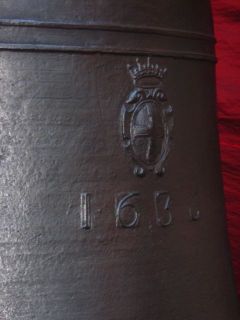
| Casting year | 1636 |
| Interventions |
It is commonly thought that the bell was damaged due to war action, however cracks in its suspending crown indicated otherwise. It was last rung on the 24th August 1974 on the occasion of the funeral of Bishop Emmanuel Galea. It was then doomed irreparable since it was broken in three parts weighing approximately 1,900, 160 and 140 kgs respectively. All was subsequently lowered from the belfry in 1989 until the broken parts were welded together in 1992 with the intention that the bell could be presented as a complete artifact at St. john’s Museum. In 2006 the St John’s Co-Cathedral Foundation took the initiative to restore the bell so that it could be rung again. Following analysis, the results confirmed that the bell could successfully be intervened upon in a manner that its future use in the belfry could be guaranteed. |
| Remarks | The Lascaris bell was originally installed in the northwest belfry. Cast in 1636 during the term of Grand Master Antoine de Paule, the bell was probably commissioned by Bailiff Jean Paul Lascaris de Castellar, successor of Grand Master De Paule. It was most probably cast in the Foundry of the Order known as the Ferreria, where cannon and all military ferrous needs were fabricated hence the name. Four armorial shields are found on the front, obverse and quarter points that have stylistically been traced on other bells cast in Malta earlier in 1619. The founder of the Lascaris bell remains yet to be identified as the bell’s profile differs from others cast contermporarily the Ferreria. Only this bell and another also found in the northwest belfry of St John’s are definitely cast by this yet unidentified founder. No other examples seem to have managed to survive to date. |
Authors of the documentation
| |
| Card editor | BUIGUES METOLA, Marcos |
| Updating | 18-06-2014 |
| 17 Pictures | |